
To help all cadres and employees quickly refocus, rally their efforts, and wholeheartedly dedicate themselves to work with the spirit of “starting with a sprint and treating the opening as a decisive battle,” Anhui Mining Machinery convened its “First Meeting of the New Year” on the morning of February 25, at which it made arrangements and deployments for launching the special campaign titled “Study, Inspect, Strengthen, and Transform.” More than 120 participants attended, including the company’s deputy chief engineers and above, mid-level managers from administrative departments, all managerial and technical personnel, as well as Party and administrative leaders from each subsidiary, branch company, and production unit.
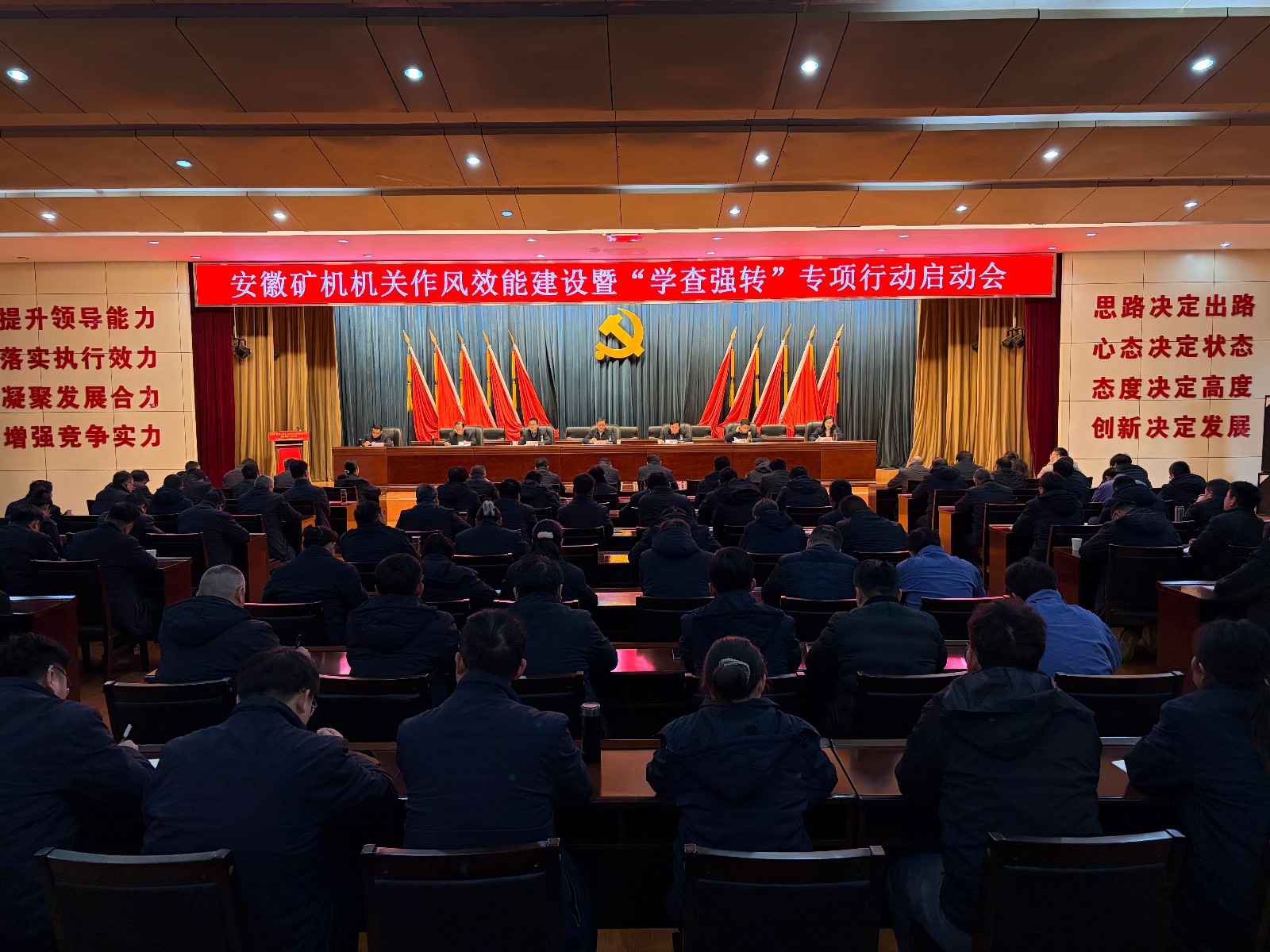
Zhuo Shujie, Deputy Secretary of the Company’s Party Committee and General Manager, chaired the meeting. During the session, He Xuelong, Deputy Secretary of the Party Committee and Chairman of the Trade Union, read out the annual commitments of the administrative departments and conveyed the spirit of the Group’s “First Meeting of the New Year.” The Business Management Department, Gongda Company, and the Electroplating Branch each delivered statements, focusing on enhancing the efficiency of administrative operations and effectively implementing the special campaign “Study, Inspect, Strengthen, and Transform.”
In his post‑Spring Festival address for 2026, Zhuo Shujie emphasized the need to refocus and get back on track, ensuring that work styles remain fully engaged. Company leaders are expected to set an exemplary standard and lead by example, while all employees should proactively adjust their mindset, adopting the principle of “returning to work upon resuming duties, aligning body and mind with professional commitment, and dedicating full attention to the task at hand,” thereby guaranteeing that “everyone is present, fully committed, and operating at peak performance.” We must embrace responsibility and forge ahead, keeping our entrepreneurial spirit and drive in top gear. All departments and production units must cultivate a strong sense of accountability and urgency, guided by the 15th Five‑Year Plan and the annual work framework of “132831,” and rigorously implement the seven “all possible efforts” directives. Furthermore, we must consolidate our foundations and maintain robust safety management. Each production unit should firmly uphold the principles of “safety first, prevention foremost, and comprehensive governance,” conduct thorough safety training and education, and carry out systematic risk‑based control and hazard identification and remediation, ensuring that the company’s workplace safety situation remains stable and continues to improve.
Cao Huaye, Secretary of the Party Committee and Chairman of the company, delivered a concluding address, calling for strengthened efforts to improve the work style of the administrative departments, thereby showcasing a new ethos and revitalizing institutional vitality. He emphasized the need to remain problem‑oriented, resolutely combat “ball‑sticking,” “waiting‑for‑the‑ball,” and “hand‑ball” practices, and focus on cultivating a fresh, proactive work ethic. Responsibilities must be clearly defined, processes accelerated, and efficiency enhanced to eradicate the malady of “ball‑sticking”; officials should take initiative and act decisively to reverse the tendency of “waiting‑for‑the‑ball”; and strict adherence to rules and law‑based conduct must be ensured to prevent “hand‑ball” behavior. At the same time, a goal‑oriented approach is essential to boost organizational effectiveness and invigorate the institution. This requires rigorous performance assessments to break the deadlock of egalitarianism through stringent standards; clear rewards and punishments to establish a culture of distinct meritocracy via timely feedback; deepened reforms to unleash endogenous momentum through innovative mechanisms; proactive learning to address skill‑related anxieties by elevating awareness and competence; robust execution to remove bottlenecks in implementation through closed‑loop management; and creative platforms to foster a spirit of emulation and excellence by setting exemplary benchmarks.
Cao Huaye put forward three key points regarding the special campaign “Study, Inspect, Strengthen, and Transform.” First, why is it necessary to resolutely launch this campaign? The initiative stems from pressing, existing problems that compel a self‑revolution. Specifically: first, insufficient cognitive capacity leads to “capability anxiety” when confronting new challenges, necessitating breakthroughs in ideological emancipation and capability enhancement; second, management effectiveness falls short, calling for a comprehensive “management health check” to reconstruct a standardized, professional management system; third, implementation of work styles remains inadequate, with internal inefficiencies persisting—thus, it is imperative to forge a robust, battle‑ready team of mining‑machine professionals. Second, how can we ensure the campaign is carried out thoroughly and taken to greater depth? First, maintain a well‑coordinated pace, with each step seamlessly linked to the next, guaranteeing that the entire process stays on track and avoids disruptions. Second, lead by example and engage all employees, ensuring full coverage while prioritizing key areas. The campaign encompasses all on‑duty cadres and workers across the company; leaders at every level constitute the “key minority” and must set an exemplary standard. Third, define concrete tasks and adopt stringent measures, making sure every stage is both actionable and implementable. Third, how can we ensure the campaign delivers tangible results and avoids mere formality? A leading group for the campaign has been established, with the principal leader of each unit serving as the primary person responsible. A regular monthly coordination mechanism should be instituted, employing checklist‑based management, project‑oriented advancement, and closed‑loop implementation. Moreover, the campaign must be deeply integrated with and advanced in tandem with the year’s priority tasks—such as aggressively securing orders, reducing costs, settling outstanding receivables, driving R&D, deepening reform, advancing planning, and attracting talent—while fostering a strong organizational atmosphere. Prominent role models emerging from the campaign—“study exemplars,” “management experts,” and “pragmatic pioneers”—should be widely recognized and publicized to serve as guiding examples. At the same time, a platform for exposing shortcomings and highlighting problematic cases should be set up to issue timely warnings. Finally, channels for employee participation and oversight must be kept open and accessible, truly rallying a powerful collective force united in running together, bearing burdens together, and achieving victory together.






 Contact number:
 Language

